


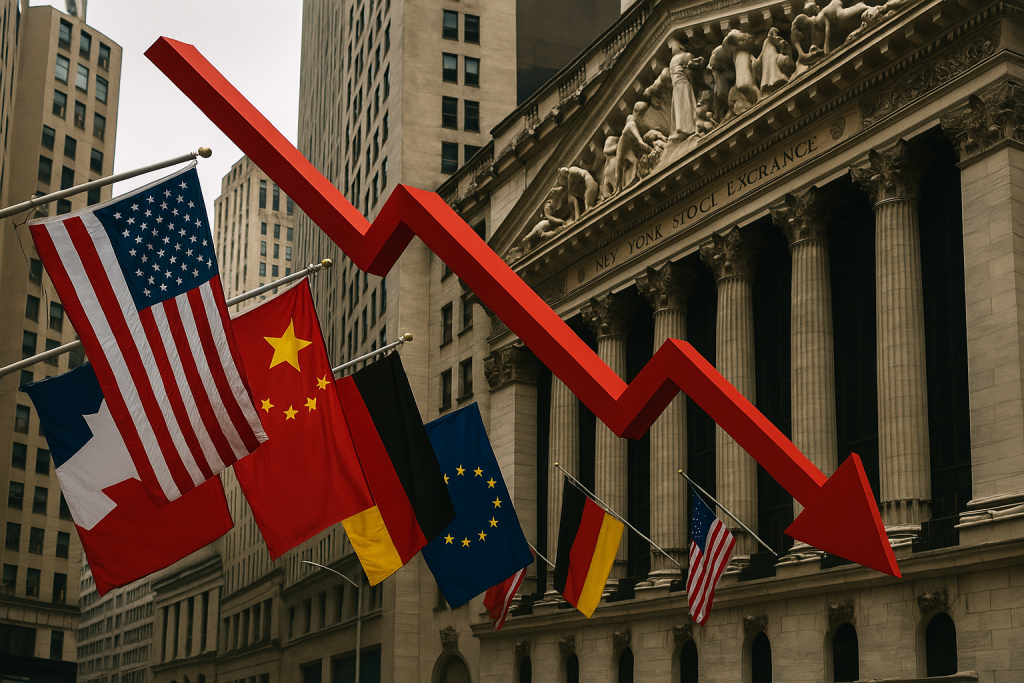
Markets kicked off the week in the red as rising trade tensions and an unpredictable policy environment left investors uneasy. With “Liberation Day” — the White House’s anticipated trade announcement — just days away, fears are growing that sweeping new tariffs could deliver a serious blow to the global economy.
Why the Market’s on Edge
Last week, President Trump floated a bold new proposal: major tariffs on auto imports, on top of other previously announced trade measures. All told, the administration’s plans could impose up to $700 billion in annual tariffs over the next decade, including a 20% tax on goods from the U.S.’s top 15 trading partners. Autos alone could represent $100 billion of that total.
Analysts at Goldman Sachs had expected something closer to a 15% average rate, and that’s with exemptions factored in. They now estimate a 35% chance of recession tied directly to the proposed trade policy. The mismatch between expectations and actual proposals is a key driver of today’s market volatility.
Signs of De-escalation?
Still, not all weekend headlines pointed to escalation. In a phone call with Canadian Prime Minister Mark Carney, President Trump reportedly softened his stance, calling Canada a “fair trade partner.” That’s significant—Canada is America’s fourth-largest import source, responsible for roughly 13% of all incoming goods. April 2nd, “Liberation Day”, will be the telling signal for what comes ahead. Tom Lee, Fundstrat Head Investment Executive, Believes it is the “bottom” before a great V-shape recovery! Which, would be an excellent set up for a momentous second half of the year.
Public Sentiment Is Shifting
It’s not just investors feeling the pressure. A new YouGov-CBS poll shows that 42% of Americans now say they feel worse off financially—up from just 28% in January. That rising economic anxiety could start to sway both public opinion and political momentum.
Meanwhile, the White House is using emergency powers to bypass Congress on trade decisions, a controversial move that’s already drawing legal challenges from lawmakers.
Markets Send Mixed Signals
Market volatility has surged—the VIX “fear index” is spiking—but not everything is moving in lockstep. Surprisingly, international stocks and high-yield bonds, which are typically sensitive to economic turbulence, are holding up better than expected.
This could suggest one of two things: either markets are overreacting to short-term trade fears, or investors are underestimating the long-term economic damage.
Bottom Line
Tariffs work. IF they are given the time to be implemented. What gives first? the consumer or the deliviering country? If immediate gratification can be delayed even just 6 months, the US economy will be able to put pressure on trade partners to even the playing field- doing so puts the US economy in position for a ridiculous boom. The days ahead could set the tone for the next phase of market movement. However, If the administration follows through on its aggressive tariff strategy, we could see sharper declines and more volatility. But if political or economic pressures lead to a softer approach, there’s potential for relief and following, the boom.
For now, uncertainty remains the only certainty—and investors are bracing for impact. If You would like more clarity in your financial future, consider a financial plan! Click HERE to reach out. And, if you like content like this, you will love our podcast- 15 Minutes of Finance. Found anywhere you listen to podcasts!
Author: James A. Walters, CRPC