


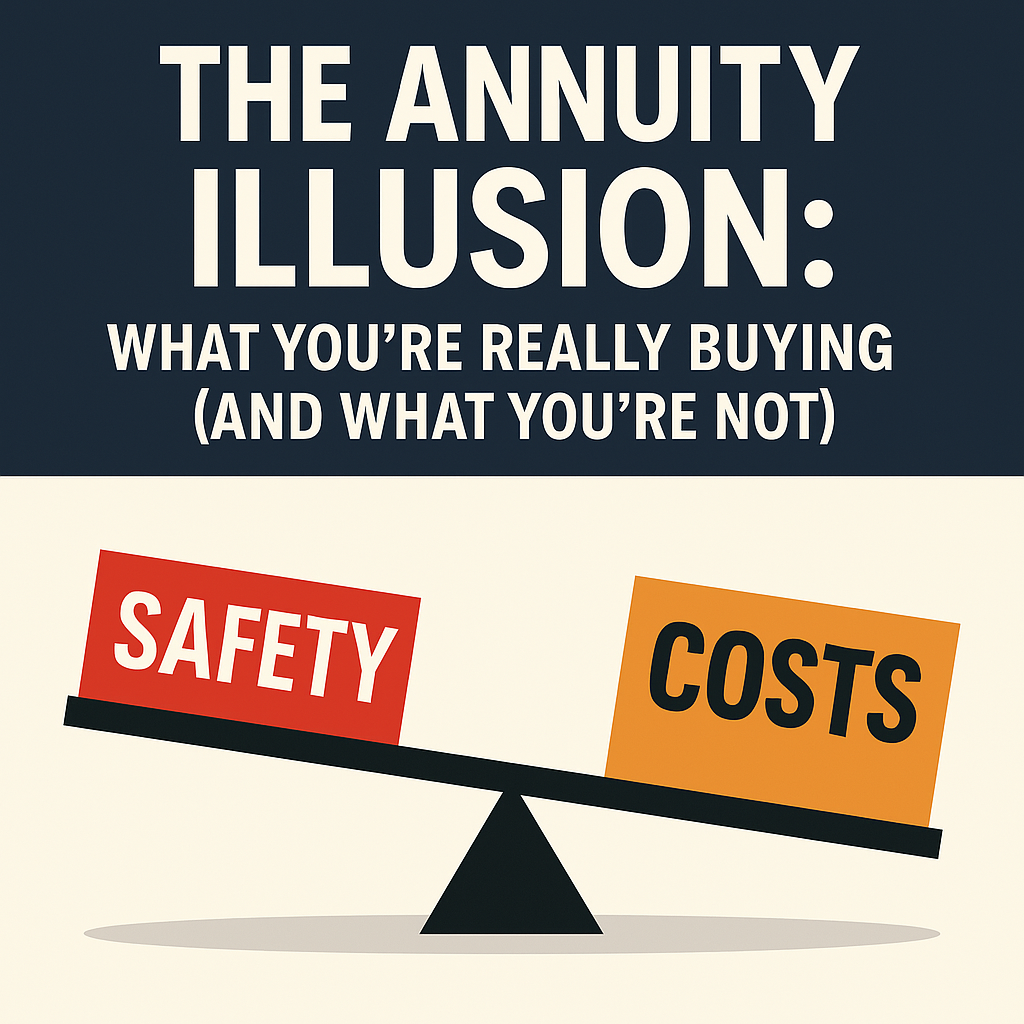
Annuities are often presented as a secure, simple way to retire. You’ve probably heard phrases like “guaranteed income for life” or “protection from market crashes.”
But are annuities really the magic solution they’re marketed to be? The truth: not always. Let’s cut through the jargon and fear-based sales tactics to explore what annuities are—and what they’re not.
Variable Annuities: The Risk Is Still Yours
A variable annuity is exactly what it sounds like—variable. That means your returns depend on the performance of underlying investments, often mutual fund subaccounts. When markets rise, your value rises. When markets fall, so does your investment.
So despite how they’re pitched, you’re still carrying significant risk.
What’s often “guaranteed” isn’t your principal—it’s an income stream later, and only if you follow every contractual rule. In many cases, you’re paying hefty fees for the illusion of safety.
What Does an Annuity Actually Cost You?
Let’s talk numbers—because cost is one of the most misunderstood (yet critical) parts of the annuity conversation.
Here’s the breakdown of average annual costs for a variable annuity:
- Mortality & Expense (M&E) fees: 1.0%–1.5%
- Investment subaccount fees: 0.5%–1.5%
- Optional riders (like guaranteed income): 0.75%–1.5%
Total average cost: 2.25%–4.5% per year
(Source: Morningstar, FINRA)
Now compare that to a well-diversified portfolio using low-cost ETFs or index funds:
- Fund cost: 0.05%–0.25%
- Optional advisory fee: 0.5%–1.0%
Even with professional management, you’re typically paying around 1%–1.25% total. And if you’re paying more than 1.5% just for investment advice, it better come with a personal chef and valet—because it’s not basic portfolio management.
Over Time, Those Fees Add Up
On a $500,000 investment:
- 3.5% annuity cost = $17,500/year
- 1% portfolio cost = $5,000/year
That’s a $12,500 annual gap—money that could have been compounding toward your future instead of someone else’s commission check.
The Fear-Based Sales Pitch
So why do so many people buy annuities?
Because they’re sold using fear.
You’ve probably heard these lines:
- “Aren’t you worried about running out of money?”
- “What if the market crashes 60%?”
- “Can you afford to lose half your savings?”
These scenarios are emotionally charged—but often exaggerated.
Historically, the average bear market lasts 10–12 months, while bull markets (growth cycles) last over 5 years (First Trust).
And here’s the irony: if you’re in a variable annuity, you’re still exposed to market volatility anyway. So what exactly is the annuity protecting you from?
Fixed Annuities: Safe, But at What Cost?
Fixed annuities are marketed as the “safe” alternative. But here’s the catch: the interest rates are often lower than inflation, CDs, and U.S. Treasuries.
As of this writing:
- Fixed annuities: ~3.5%–4.5%
- 5-year CDs: ~4.5%–5.25% (Bankrate)
- 10-year U.S. Treasuries: ~4.2% (U.S. Treasury)
And to lock in those fixed annuity rates, you often have to give up access to your money for years during the surrender period. That’s not flexibility—that’s a trap.
Let’s be honest: U.S. Treasuries are the safest investment in the world. So why give up liquidity for a lower return from an insurance company?
The S&P 500 Is Safer Than They Want You to Believe
Let’s talk about real ownership and long-term strength: the S&P 500.
This index represents the 500 largest companies in the U.S.—a broad slice of the entire economy. When you invest in it, you’re not just buying stock—you’re buying a piece of the U.S. economy.
And here’s the kicker: most annuity providers are part of the S&P 500.
So if the market crashes and the S&P 500 goes to zero… do you really think that insurance company backing your annuity will still be around?
Probably not.
Annuities are sold to “protect” you from market collapse—yet they rely on the very same market to stay solvent. That’s the contradiction.
The House Analogy: Is One Room Safer Than the Whole House?
Imagine the S&P 500 as a massive house with 500 rooms. Each room is a company—Apple, Amazon, Microsoft, etc. One of those rooms? Your annuity provider.
Now ask yourself:
Can one room be safer than the entire house?
If 60% of the house collapses, protecting a single room won’t help. You need the whole foundation to hold. That’s the flaw in annuity logic. It’s comforting, but not realistic.
Where Annuities Can Make Sense
Let’s be clear: annuities aren’t inherently bad. They can be useful—when used intentionally.
One smart use? Covering fixed retirement expenses.
If you need $45,000/year (adjusted for inflation) to cover essential living costs, you could purchase an annuity to guarantee that income. That’s thoughtful, strategic planning.
But putting a large portion of your net worth into annuities is rarely wise—unless your situation is unique. And those cases are the exception, not the rule.
Unfortunately, annuities are too often sold like they should be the rule.
Final Thoughts: Use the Tool—Don’t Be the Tool
An annuity can play a role in your retirement plan—but it should never be purchased out of fear or confusion. And it’s definitely not a magic bullet.
Understand what you’re actually buying.
Understand what it actually costs.
Understand who really benefits from the sale.
Because far too often, the person benefiting the most… isn’t you.
If this resonated with you, and you’d like an annuity or retirement plan review, please reach out here. and If you perfer listening over reading, check out our nationally recognized podcast! 15 Minutes of Finance!
Written by: James A. Walters, CRPC
Sources:
- Morningstar: Understanding Variable Annuities
- FINRA: Variable Annuity Fees
- First Trust: Bull & Bear Market History
- Bankrate: CD Rates
- U.S. Treasury: Yield Curve
Disclosure: This content is provided by West & Walters Tax and Wealth Management, a DBA of 77 Financial Group, a Registered Investment Adviser (RIA). The information presented is for educational purposes only and is not intended as specific investment, tax, legal, or financial advice. Always consult with a qualified financial professional before making decisions based on this content. If you’re interested in personalized guidance tailored to your financial situation, we’d be happy to help — reach out to schedule an appointment.